Monday, July 02, 2007

Happened to read this good article from Seattle Post Intelligencer on Leadership - Its really good! Thanks to Seattle PI!!

Becoming a great leader depends on skill, not talent
By MAUREEN MORIARTY

How did your boss get to be a great boss?
While some believe that leaders are "born, not made," research shows that great leaders are, in fact, made. They gradually acquire effective leadership competencies throughout their careers through experience, training, mentoring and typically a lot of hard work.
Perhaps as important are the natural gifts, talents and traits that help a potential leader realize his or her leadership potential. Personal traits like integrity and character are more on the born, not made, side, as well as drive and cognitive/problem-solving ability. However, without experience, training and mentoring, personal traits are not enough. No one is born with a natural ability to effectively lead. Traits like business acumen, coaching/mentoring skills, persuasiveness and emotional intelligence are learned and developed, often over a lifetime.
So how did your great boss develop leadership competencies? Here are a few of the common characteristics we find in most successful leaders today.

They had great leadership role models. Most great bosses identified someone along the way whose skills and behaviors they wanted to emulate. They found or made opportunities to learn and grow from them, even changing jobs so they could work with a great boss (or leave a bad boss). These "great bosses" helped them see their potential greatness. They cared about and supported their development, providing focus, challenge and reinforcement.

They took on new and challenging job assignments. Research on thousands of top executives (by the Center for Creative Leadership) directly links leadership success to learning from critical on-the-job experiences. Most of us learn best by experience, rather than simply reading or hearing it taught in a course.

They learned from critical hardships and events. Experiences like turning around an organization in trouble or starting a new project, product or team from scratch are often instrumental in leadership development. Most successful leaders will tell you they learned the most from their greatest mistakes. Effective leaders set an expectation that mistakes will happen; what is important is how mistakes are resolved and what we can learn from them.

They are adaptable. Great bosses aren't rigid. They got to be "great bosses" by being self-aware, reflecting on behavioral choices, learning from mistakes and modifying behaviors to positively impact relationships and organizational performance.

They encouraged feedback. The best bosses continually seek feedback and develop systems to make it safe for people to give it to them. When told what they are (or are not) doing well, they genuinely reflect and, as required, make behavioral changes.

They understand the value of continual learning. John F. Kennedy said, "Leadership and learning are indispensable to each other." To climb the corporate ladder in today's dynamic workplace requires a commitment to continual learning. Great bosses actively encourage ongoing training and education in their organization and for themselves. They participate in and support higher education as well as recognize the value in specialized training in the "soft" leadership skills (i.e., personnel management, facilitation, conflict resolution and team leadership skills). They utilize the various tools and applicable theories and behaviors that translate to more effective leadership.

They have stayed connected - to themselves and to those they lead. Great leaders can stay connected to others even in conflict or difference (i.e., they have high emotional intelligence). They are authentic, true to themselves and models for what they believe in (and ask for from others). They are clear about their core values, avoid pretense and own their truth without blaming.

They have developed personal authority and integrity. These are the leaders that you will "go to the line" for without hesitation. For those of us lucky to have worked with one of them, we understand the value of their leadership is immeasurable.

The greatest waste of all is not to realize your full potential.

What to do?
  • Get a mentor or coach.

  • Expand your horizons (go back to school, go to a training or seminar).

  • Take on a new job assignment.

  • Ask your management, "What can I do?" as a step toward being the next great leader.

  • Leadership development is a continuous process, not a one-time event. It's a lifelong journey.
Your great boss is (no doubt) still working on his or her leadership development.

Friday, April 06, 2007

Choreography vs. Orchestration

These two words are interchangeably used in Business Process Modeling/Management (BPM) related articles. But they are different in fact. In choreography, the services/business components are interconnected and programmed in such a way that they participate in a pre-planned business flow. Whereas in Orchestration, there will be a dedicated orchestrator who controls and decides who should work on what time and condition in the flow. This orchestrator will also be there in the runtime environment to coordinate activities of services (fine grained) and business components, but no one as choreographer in other case. BPEL Engine (Business Process Execution Language) is an orchestrator which uses BPEL in XML format as running script.

Tuesday, January 23, 2007

Experience of SCDJWS Test

Last week, I could clear the test – Sun Certified Developer for Java Web Services (SCDJWS). I am writing this blog to share my experience towards preparation for the same.

It took about 7 to 8 weeks and couple of no-deviation-no-distraction hours for the preparation. I am a good Java programmer (especially server components programming), that’s it. I did not have any good work-hands-on with web services-SOA development. Also I don’t have any work experience on XML-Namespace-Schema area. With all these background I started preparing for the test.

I took the following preparation materials:
  • “J2EE Web Services” by Richard Manson Haefel

  • http://www.xyzws.com/ – SCDJWS Study Guide

  • J2EE 1.4 Tutorial

  • http://java.boot.by/wsd-guide/- Mikalai’s Study Guide

  • www.xyzws.com mock

  • Mikalai’s Mock exam (I bought from him – You need send a mail to him who can direct you on buying process)

  • Free Trail of Wizhlab

  • ePlanetlab’s Mock (I bought through their site)

I would like to thank my friend Mr. Akbar Basha Rahamatulla (akbarbasha.r@gmail.com) who prepared and cleared the same test with me. We used to have end-of-chapter discussions for each topic in the test curriculum and clarify our questions and reassure our understanding. This was quite useful on top of mutual-morale support for each other.

This test is very useful for those who want to fly with next generation IT systems development which is “the great SOA”.

Monday, January 22, 2007

Ethics and Values

I happened to read one of leadership articles on ethics and values written by Narayan Murthy, Chief Mentor of Infosys.

He has explained about personal leadership qualities of a CEO, what the person should have from ethics perspective. It is really a good article.

For complete article:

http://www.rediff.com/money/2007/jan/22murthy.htm

Saturday, January 06, 2007

Wish you a happy new year 2007!

One of my resolutions for this year is to blog more in this site!

Today I am taking the topic of how to set goals and ways to stick to it:

First, what is goal?

Goal is something that you want to accomplish in due course of time which can be personal or professional side. A goal is born from a strong wish or desire to do something. Isn’t it? I select the goal which should be accomplished by considering all of my constraints, attitude and ability. I believe myself that I can accomplish the set goal. Think about someone who has achieved such goal as role model for you. If you can be in touch with the person, learn the lessons that he has practically learnt for reach that goal. As always wise human learns from others experiences too. And make sure that your goal reminds you always, write a post it!

Okay now goal is ready, its time to plan and strategize to reach the goal. Identify resources, time and efforts that you need to spend. Yes there must be lot of tradeoffs among all the aforementioned factors. Come to a balanced tradeoff so that your goal is not distracted.
Identify the factors or influences that may distract you from the goal upfront! Include effort to work on these factors as well.

Identified and planned, so next stage is execution.

Have a track record to measure your performance. Yes you must have a log (hand-written) to show your progress. Believe me, initially it will be boring to the core, but if you start seeing some progress, that’s it. You are on your way to reach your goal. This is the simple performance monitoring technique that I follow.

One thing is very important in this context is: Willpower (Motivation and Internal fire). Keep it high so that you will not get dragged down.

Saturday, July 29, 2006


Do you know this? Javascript can hack your internal corporate network! For more information read:

http://news.com.com/JavaScript+opens+doors+to+browser-based+attacks/2100-7349_3-6099891.html?tag=nefd.top

Thursday, June 22, 2006

Cinematography School (Mindscreen Film Institute)
by Rajiv Manon (http://en.wikipedia.org/wiki/Rajiv_Menon)


It is a nice opportunity those who are aspiring to excel in cinematography field. Rajiv Manon the cinematography icon of south Indian film industry has started an institute named Mindscreen Film Institute, inaugurated by the direction legend Mani Ratnam by last May 2006.
Highlights of the institute and course:

  • Fully integrated film production company
  • Any graduate is eligible for this course
  • Any currently working in the industry as assistant cameraman can also pursue
  • Duration is six months only
  • Course fee Rs. 1 lakh
  • For details the institutes website http://www.mindscreen.co.in/

Wednesday, June 21, 2006


India Inc. in TIME

The current issue (June 26, 2006) of Time Magazine (http://www.time.com/) focused on the growth of the world largest democratic country – India and how does it important to America.
There are series of articles that are penned to substantiate the growth of India in multi dimensions, in that the one that is quite interesting one is “India Awakens”. The highlights of this article include:

  • Agreed statement that the Indians are changing the world!
  • India's economy is growing more than 8% a year and the country is modernizing so fast that old friends are bewildered by the changes that occurred between visits. The economic boom is taking place at a time when the U.S. and India are forging new ties.
  • India is the un-China
    • Like side:
      • Largest democracy the world has ever seen
      • US learns that with the democrats it is easier to talk to than communist apparatchiks
      • Making friends with India is a good way for the U.S. to hedge its Asia bet
    • Unlike side:
      • Prosperity and progress haven't touched many of the nearly 650,000 villages where more than two-thirds of India's population lives
      • The nation has more people with HIV/AIDS than any other in the world
      • Transportation networks and electrical grids, which are crucial to industrial development and job creation, are so dilapidated that it will take many years to modernize them
  • Conclusion
    • India is younger and freer than China
    • India is playing catch-up, for sure, but it has the skills, the people and the sort of hustle and dynamism that Americans respect, to do so

Good sign for India!

Tuesday, June 13, 2006


Best Self - Motivation Literature

“A Bias for Action” by Heike Bruch, Sumantra Ghoshal from Harvard Business School Press

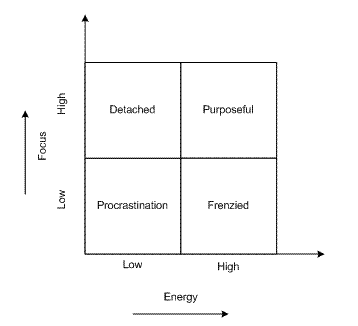
In this book the authors explain about the nature and work style of executives/managers in the organization. All the executives can be classified into any of the four categories based on the energy and focus levels of the individual as shown below:

Any one can use the information in the book to find out the current level of the individual. For example, if I am falling under Detached category of manager/executive, then using the guidelines that are available in the book, I can work to move to Purposeful area wherein all my actions are purposeful to the organization/team/etc.

In this book the authors clearly explain about the need and difference between motivation and willpower. What an executive should do to have these attributes. This is really very good for one who wants to motivate and build strong executive competency. This is highly recommended!

I could see a PPT by Sumantra Ghoshal which can be useful: Ghoshal’s Leeds PPT

For more review information:

Visit Amazon.com

Thursday, June 08, 2006

Lessons Learnt from my Professional Life

Being a software professional/consultant in IT Services/consultancy industry, I learnt significantly the following lessons. I hope these lessons might helpful to others.

  • Should have clear career goal - Analyze and make appropriate decisions at right time – For many situations the consultants are not given right vision or appropriate options. They are forced to take what is available. Sometimes this is OK, but not always. If you accept what ever that are forced to you that are not in your career plan then you are not going away from your plan – Be careful! The career plan either could be in technical, functional or managerial.
  • Unplanned Performance Review – You should know your performance indicators in which you are going to be evaluated in advance – during review period itself. Most cases the manager fails to define performance indicators and their expected values in advance, but they do try to do performance appraisal after the review period. This is not at all accepted! – Suffering party is always the subordinates – NOT SUPERVISORS!
  • Be clear with organization’s Standards, Policies, and Procedures, at least from quality perspective, if you are in delivery side.
  • Big Picture - Understand the organization strategy/objective and find out how you are contributing to achieve that objective.
  • Have good network of relationships with others in the project/organization – will learn so many good things from others. Of course even negative lessons too!
  • Enhance your knowledge always by learning – Sharpening the saw!
  • Presentable – Make sure that you do enough marketing so that your boss (and other appropriate stockholders) knows what you have accomplished – Write somewhere in your scribble pad or maintain your own activity log. This will help you in many aspects. Like during review, this will serve as a tool to showcase your accomplishments.
  • Build your soft skills as required – Oral and written communication, presentation skills, handing situations, facing customers, controlling your emotions, etc.
  • Professional Environment – Try to maintain professional environment as much as you can that includes oral and verbal communication.
  • Try to look for change in career at least once in a year – Or you will be locked in one production support project for YEARS! – Wherein the scope to learn new stuff is limited.
  • When you shift projects – make sure that you know your complete roles and responsibilities
  • Try to participate in professional level corporate activities – a way to build relationships with top management
  • Be effective during office time; spend time for your personal side. Morning times are always efficient – Use efficiently!
  • Always try to lead your leader, but at the same time make sure that you are not led by your subordinates!

Tuesday, May 30, 2006


The novel "Parisukku Po" by T. Jayakanthan is one of the best novels that I really enjoyed reading.

There are two items that made me to blog:
  • The way in which he has explained about “Modernization” which is completely different from “Westernization” – that everybody thinks.
  • And the wonderful comparison of Carnatic music (the indian classical music – “Saahithyam” makes the person perfect) with the western music (the one can be written down and has alphabets of its own)

… the novel is very rich in content. It serves as a source of information for realizing many basics that we live with.